 "Generative Authority" | FWF-START Award 2024

Meet our team: Chloé Agar
Starting today, Chloé will be working on the Coptic side of the project. Welcome aboard, Chloé!

While training in Egyptology and archaeology at the Universities of Oxford and Liverpool, Chloé specialised in Coptic. She held the Deutsch Scholarship in African History at St Cross College, Oxford and completed her DPhil thesis in history in 2022, titled “On the Representation of Visions in Coptic Hagiographical Texts”.
Her research focuses on supernatural phenomena in hagiography and their implications for lived religion in Late Antique and Early Islamic Egypt. To this end, she is contributing entries on Klaudios and Merkourios to the Cult of Saints in Late Antiquity database and has recently been contracted to write a chapter for The Oxford Handbook of Angels and Demons.
In Oxford, Chloé held an Ashmolean Junior Teaching Fellowship from 2022 to 2023, worked and taught in the Faculty of Asian and Middle Eastern Studies, and collaborated on several projects on secondary epigraphy with Hana Navratilova, including “Graffiti Gazetteer”, and was the lead editor of Graffiti Quest (Brill, 2026). She previously worked with Dan on the “1Clement.VMR” project from 2020 to 2024 and, alongside Andy, became an active member of Oxford’s Syriac Studies community.
Meet our team: Rachael Helen Banes
Starting in June, Rachael is working on the presence of GenAut figures in epigraphic sources. Welcome aboard, Rachael!

Rachael is interested in the epigraphy and wider visual culture of the ancient and medieval Mediterranean. Her past work has focused on graffiti, and the placement, distribution, and content of informal inscriptions, in order to reconstruct the behaviours and experiences of past communities.
Rachael completed her PhD at the University of Birmingham in 2023, titled: “Scratch That: A Comparative Approach to Graffiti in the Late Antique Eastern Mediterranean”, for which she received the Rodney Hilton Prize in Medieval Studies. Between 2021 and 2025 Rachael was a team member on “Epigraphies of Pious Travel”, an FWF project examining graffiti associated with pilgrimage in the Byzantine Sphere. As a member of the team, Rachael was responsible for collecting, editing and publishing the Greek graffiti.
Meet our team: Sara Giorgetti
Starting in June, Sara will be collaborating with the GenAut team on Ps.-Clementine literature across all languages of the project. Welcome aboard, Sara!

Sara is trained in Philology, Literature and History of Antiquity at Roma Tre University, where she completed her Master’s Degree in 2017 with a thesis in the History of Early Christianity. In July 2023, she completed her PhD at the University of Roma Tre (PhD in Civilizations and Linguistic-Literary Cultures from Antiquity to Modernity, curriculum in Greek and Roman Civilization and Tradition) in co-tutorship with the Université de Fribourg (Faculty of Theology). Her doctoral research focused on the pseudo-Clementine letters Ad Virgines in their Syriac, Coptic, and Greek versions.
She is Lecturer in Greek Literature at the Faculty of Christian and Classical Letters of the Salesian Pontifical University in Rome. Her research interests include the history of early Christianity and Syriac studies, with particular attention to pseudo-Clementine literature and gender history.
GenAut 2026 Seminar Programme is live!
We’re thrilled to share with you the programme for the 2026 online seminar of the project! This year’s topic is “The Followers of the Apostles in Cultic Contexts,” and the series is curated by our colleague Maria S. Thomas.

Meet our team: Christoph Scheerer
Starting on February 1st, Christoph is the third researcher to join the GenAut team. He will be working on the Greek side of the project. Welcome aboard, Christoph!
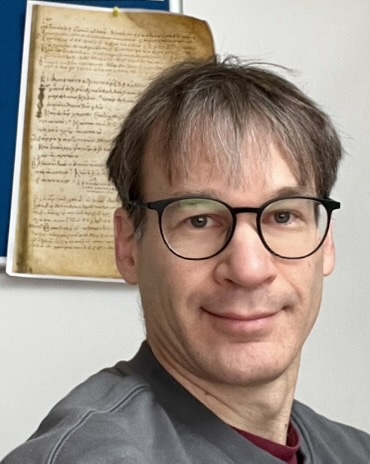
Christoph studied theology, Renaissance trombone and musicology at the Universities of Tuebingen, Berlin and Trossingen. He found his passion for manuscripts and patristics in 2006 working with Volker Drecoll for the edition of Augustine, Späte Schriften zur Gnadenlehre (CSEL 105). He is also working on editions of the ascetic writings of Nilus of Ancyra, and of the commentary on Isaiah of (Ps.?) Basil (both forthcoming).
His doctoral thesis in Musicology, defended in Trossingen in 2023, focuses on “Die Bedeutung und Verwendung von ₵ in musikschriftlichen Quellen zur Mensuralnotation des 15. bis zum Beginn des 17. Jahrhunderts”, and examines more than 100 theoretical writings on music about the meaning of the stroke in the sign for tempus imperfectum.
Before joining the GenAut-team in February 2026 to work on the Greek side of the project, Christoph collaborated in several projects of Uta Heil at the University of Vienna, Institut für Christentumsgeschichte: “Formatting European Christianity” (about dogmatic writings on trinity and christology of Fulgentius of Ruspe); “Athanasius Werke III,2. Die Entwicklungen in den Nachfolgestaaten des Römischen Reiches bis zum Symbolum Quicumque”; “The apocryphal Sunday in Late Antiquity”; and “Digital edition of (Ps.-)Athanasius of Alexandria: Expositiones in Psalmos”.
The 2025 GenAut online seminar is completed!
With the recent last talk – by Janet Spittler, on “Prochorus: Sidekick and Scribe” – the 2025 series GenAut characters in relation to the apostles is now completed. Recordings below.
The 2026 series, GenAut figures in cultic contexts, is curated by Maria S. Thomas,
and the programme will be announced soon.

ERC Consolidator Grant for Dan Batovici
We’re happy to announce that Dan Batovici, the GenAut project’s PI, was awarded an ERC CoG for the complementary project CLAIM | “Secondary Pseudepigraphy.“

Photo credit: Sameer Khan/Fotobuddy.
If the FWF GenAut project “Generative Authority” studies the complex literature where minor figures of early Christianity become main literary characters (in apocrypha or hagiography), the ERC CLAIM project “Secondary Pseudepigraphy” will investigate the literary phenomenon where these figures became authors (of letters, theological tracts, canons, or indeed apocrypha) in the context of ancient practices of authorship.
You can find the press release and the full list of winning projects here: The ERC selects 349 mid-career researchers for €728 million in Consolidator Grants
Meet our team: Maria S. Thomas
Starting on September 1st, Maria is the second researcher to join the GenAut team. She will be working on the Syriac side of the project. Welcome aboard, Maria!

Trained in art history and theology at the Universities of York, Oxford, Salzburg, and VU Amsterdam, Maria is interested in the textual, material, and visual cultures of premodern Syriac Christian communities. Her research broadly focuses on the materiality of texts and writing across media, and on their social, and particularly liturgical, value.
Maria’s doctoral thesis at VU Amsterdam examined the “textual memorials” produced at two Syriac monasteries—the Monastery of Mary Magdalene in Jerusalem and the Monastery of Moses in Nebk—between the eleventh and thirteenth centuries, analysing how these texts constructed and articulated collective identity and memory.
She serves as the Middle Eastern Studies editor for The Digital Orientalist. Her forthcoming publications include contributions to Visual Culture in Medieval Syriac Traditions (De Gruyter) and Speculations: The Centennial Issue of Speculum.
Maria had already collaborated with the project having given a paper in the online seminar of the project: “Mary Magdalene in Twelfth-Century Syriac Fenqitho Manuscripts from Jerusalem.“